Nine hundred years ago, this was frontier land — the edge of a kingdom that didn’t fully exist yet, and the edge of a war that had already lasted a century. This is the story of the knight who looked at a hill above a small river and decided it would become the headquarters of the most powerful military order in Christendom.
Before Tomar had a castle, a convent, or even a name that history remembers, it had a river, a scatter of Roman ruins, and a war running through it. The Nabão flows gently now, past cafés and a wooden water wheel, but in the 1150s this stretch of central Portugal sat right on the border between the young Christian kingdom to the north and Muslim al-Andalus to the south. Whoever controlled this frontier controlled the road south. That’s the reason Tomar exists at all
A knight who had already seen Jerusalem
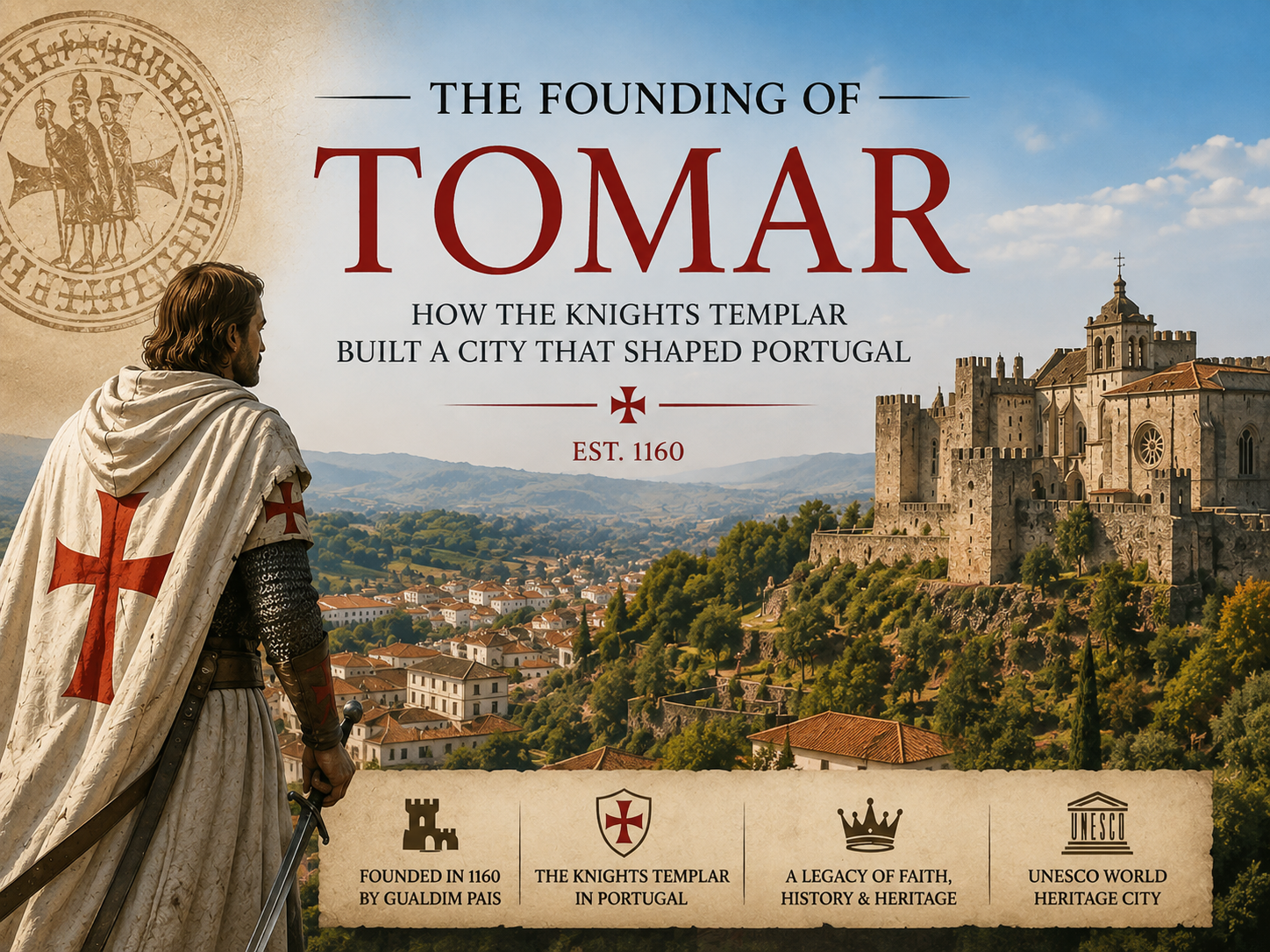
The man who made the decision was Dom Gualdim Pais, and by the time he arrived here he was no ordinary knight. Born around 1118 in northern Portugal, Pais had fought alongside King Afonso Henriques — the man who would become Portugal’s first king — in the campaigns that carved the kingdom out of Moorish territory. In the late 1140s he joined the Second Crusade and spent roughly five years in the Holy Land as a Knight Templar, reportedly taking part in the siege of Gaza. He came home with something few of his fellow Portuguese nobles had: first-hand experience of how the Templars built, fought, and governed in the East.
That experience mattered. In 1157, Pais was named the fourth Grand Master of the Knights Templar in Portugal. He was, in effect, being handed a problem: the Order needed a permanent, defensible headquarters on a still-dangerous frontier, and nothing suitable yet existed.
Why this hill, specifically
Pais chose a low ridge above the Nabão, roughly 140 km northeast of Lisbon, on a stretch of land the Order had already received from Afonso Henriques. Practically, the site made sense — a river for water and trade, a hill for defense, and a position that let the Templars watch the southern approach to the emerging Christian territories. Local tradition adds a more romantic layer: it claims the surrounding countryside forms a chain of seven low hills, echoing Jerusalem, Rome, and Constantinople, and that Pais read this as a sign the location was meant to hold something significant. Whether or not that story is more legend than land survey, it’s the kind of detail that has followed Tomar ever since — a place that was always seen as more than just a fort.
On 1 March 1160, construction began. It would take around nine years to complete the core of the castle and its chapel — a serious undertaking for the period, and a sign of how much the Order was willing to invest here.
A castle built like nowhere else in Portugal
What Pais built wasn’t a typical Iberian castle. It was the first Templar stronghold in Portugal designed from the ground up as the Order’s headquarters, and it shows: a keep, deliberately angled walls, and construction techniques — including the alambor, a sloped stone base that made the walls harder to undermine — that Pais had picked up from fortifications he’d seen in the Holy Land. At the center of it all sat a round chapel, the Charola, modeled directly on the Church of the Holy Sepulchre in Jerusalem. It’s still there today, essentially unchanged, and it remains the single most recognizable interior in Tomar. (We go inside it in detail in part 2 of this series.)
A town, not just a fort
A fortress alone doesn’t hold a frontier — people do. In 1162, two years after construction began, Pais issued a foral, a feudal charter that gave the settlers of Tomar formal rights and relatively generous terms by the standards of the day: land, protections, and incentives designed to attract families to a border town most people would otherwise have avoided. It worked. Tomar grew from a military outpost into an actual settlement, one that would go on to outlive the Templars themselves by centuries.
Pais didn’t stop at Tomar. Over the following decades he oversaw the building or restoration of Templar castles across the frontier — Almourol on its river island, Pombal further south, Monsanto and Idanha on more exposed ground — but Tomar stayed the seat of the Order in Portugal, the place everything else answered to.
The test that proved it worked
The choice of site, the military engineering, the town charter — all of it was still just theory until 1190, when an Almohad army crossed the Tagus and put Tomar under direct siege. Pais, by then in his seventies, led the defense himself. We tell that story in full in part 3, but the short version is this: the castle held. The frontier held. And Tomar’s reputation as the most secure Templar position in Portugal was no longer a claim — it was a fact, tested in six days of fighting.
What’s still here today
Almost everything visible on Tomar’s hill started with the decisions made in these first years: the site Pais chose, the Charola he built, the walls engineered to withstand exactly the kind of siege that came in 1190. Later centuries would add Renaissance cloisters, a Manueline church, and eventually UNESCO status — but the foundation, literally and historically, is Gualdim Pais’s.
Planning to see it in person? The Charola and castle walls Pais built are the oldest part of what’s now the Convent of Christ. For opening hours, ticket prices, and how much time to set aside, see our complete visiting guide to the Convento de Cristo.
Continue the series:
- The Founding of Tomar (this article)
- Inside the Charola: Tomar’s Round Templar Church, Explained
- The Siege of Tomar (1190): The Six Days That Saved the Town
- From Templars to the Order of Christ
- Henry the Navigator in Tomar
- King Manuel I and the Manueline Rebirth
- The Jewish Community of Tomar
- Tomar After the Templars: Becoming a UNESCO Site